
Service Overview
The Most Expensive Cabling Decision You'll Ever Make Is the Cheap One
We've walked into Toronto offices where the network cabling looked like spaghetti had fallen into a server rack. Unlabelled cables going everywhere. Cat5e, run in 2012, still carries the whole office. Wireless access points placed wherever someone could reach a ceiling tile — not where the signal actually needed to go. Three ISP routers daisy-chained together because nobody knew what was behind the wall.
It works. Barely. Until it doesn't.
And when it stops working — when a client presentation dies because the boardroom drop is on a cable run that's been crimped behind a partition wall for six years — the cost of fixing it is three times what it would have cost to do it properly the first time.
Structured cabling is the physical foundation that every device in your building depends on. Your internet connection, your VoIP phones, your access control readers, your IP cameras, and your wireless network – all of it runs over cables that are either organised, labelled, and tested or they're not. There is no middle ground that holds up over time.
MV Tech Pro designs and installs structured cabling and networking systems for Toronto businesses — from a single-floor office fit-out to a multi-building campus with a fibre backbone. This page covers what we do, how we do it, what it costs, and what questions you should actually be asking before you hire anyone.
What Is Structured Cabling — And Why Does It Matter for Your Toronto Business?
Structured cabling is a planned, standardised wiring infrastructure that organises all the data, voice, and low-voltage cables in your building into a single managed system.
Instead of running individual cables point-to-point between devices — one cable from the server directly to a workstation, another directly to the phone, another directly to a camera — structured cabling routes everything through a central distribution point. Every cable run goes from a wall outlet or device back to a patch panel in a network closet, where it's organised, labelled, and connected to your active network equipment.
Why does this matter in practice?
When you need to move a workstation in a point-to-point system, you're pulling cables. In a structured system, you move a patch cord. Two minutes.
When you add a new team member in a point-to-point system, you're potentially running a new cable through finished walls. In a structured system, you check the panel for an open port. Done.
When something stops working in an unlabelled mess, you're tracing cables by hand trying to figure out which grey cable goes where. In a documented structured system, you check the label, find port 14 on panel B, and know exactly what's happening.
When you sell or lease the property, a properly documented structured cabling system is a selling point — building managers, buyers, and new tenants know what they're getting.
That's the real value of structured cabling. Not the cables themselves — the organisation, the documentation, and the ability to change things without tearing the building apart.
Our Structured Cabling & Networking Services in Toronto
Cat6 and Cat6A Cabling Installation Toronto
These are the two copper cable standards you'll encounter in every Toronto commercial cabling conversation in 2026, and the difference between them matters more than most contractors will tell you.
Cat6 supports gigabit speeds (1 Gbps) at the full 100-metre channel length and can push 10 Gbps but only up to around 55 metres. For a standard office where workstations are within 30–40 metres of the network closet, Cat6 is perfectly capable.
Cat6A supports full 10 Gbps at the complete 100-metre distance, handles heavier Power over Ethernet (PoE) loads without heat issues, and is the right choice for any new build where you have access to ceiling cavities before walls close. The cost difference per drop between Cat6 and Cat6A is relatively small—around $30–$50 per run. The cost of retrofitting Cat6 with Cat6A three years from now when your applications demand more bandwidth is exponentially higher.
Our position: for any new Toronto office build in 2026, Cat6A is the floor. For retrofits or upgrades to an existing Cat6 system, we assess the use case and tell you honestly whether the upgrade is worth the cost.
What a Cat6/Cat6A installation includes from MV Tech Pro:
- Full site survey and cable run design before any work begins
- Cable pulled and routed through ceilings, walls, and conduit — cleanly, with no cables left unsecured
- Termination at wall outlets with keystone jacks and faceplates
- Termination at patch panels in your network closet
- Every run numbered and labelled at both ends to match your documentation
- Fluke testing on every single drop — not a sample, every drop — with a certification report
- As-built documentation showing every run, every port, every panel
In the Toronto market in 2026, structured cabling costs between $150 and $350 per data drop fully installed depending on cable grade, building accessibility, ceiling type, and run length. A 20-workstation office typically runs $3,000–$8,000 for the cabling scope. A 50-person office with full Cat6A, fibre backbone, and one network closet typically lands between $15,000 and $35,000.
We'll give you an exact number after a site visit. Not before.
Office Network Installation Toronto
Moving into a new Toronto office is one of the most common triggers for a structured cabling project — and one of the highest-risk moments if the cabling gets rushed or done by the wrong contractor.
The moment walls close on your new tenancy is the moment cabling becomes exponentially more expensive. A cable drop that costs $200 during the pre-wire phase costs $600–$900 to retrofit through a finished wall. We coordinate directly with your general contractor, architect, and property manager to get structured cabling in before drywall — because that's when it should happen.
Our office network installation in Toronto covers:
Pre-construction cabling — we pull cable before walls close, coordinate with your GC's schedule, and document every run as we go. This is the lowest-cost, highest-quality option for any new build or major renovation.
Office fit-outs and retrofits — if walls are already finished, we work within them. We use fish tapes, wall probes, and ceiling tile access to route cable with minimal disruption and minimal patching.
Workstation drops — the industry standard is two data drops per workstation: one for the computer, one for a secondary device, VoIP phone, or future redundancy. The marginal cost of the second drop during installation is around $30 in materials. The cost to add it later is $400–$800.
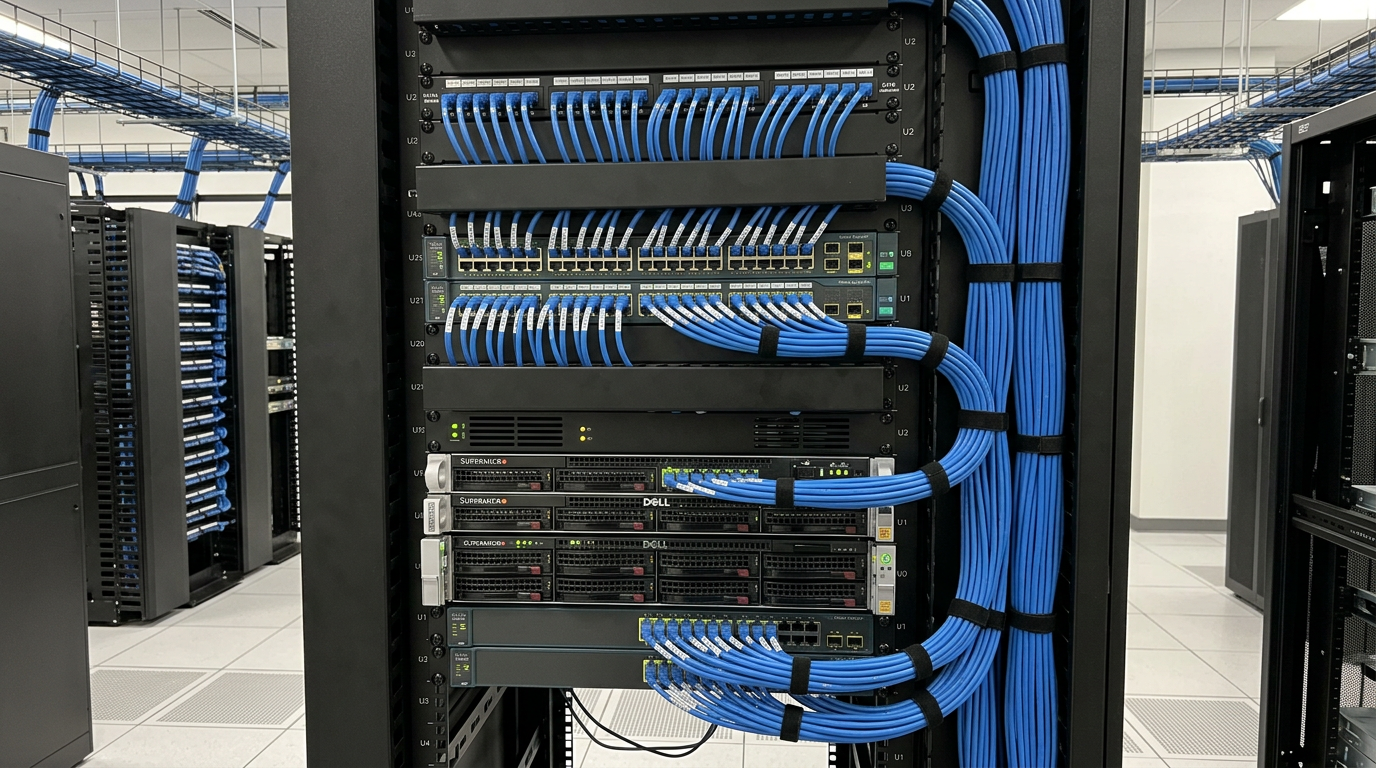
Patch panel and rack installation — all drops terminate at a properly sized patch panel in your network closet, with cable management, labelling, and a rack that doesn't look like a nest.
Switch and router installation — if you need active equipment, we install and configure managed switches, routers, and firewalls as part of the scope.
VoIP cabling — if you're running IP phones, we ensure dedicated drops are in place with PoE provisioning at the switch level.
Enterprise WiFi Installation Toronto
Bad WiFi in a Toronto office is almost never a hardware problem. It's a placement problem.
Most offices have wireless dead zones because someone put access points where they could reach a ceiling tile, not where the signal needed to go. Or they have one AP trying to cover an entire floor. Or they're running enterprise APs on a consumer Netgear router. Or their APs are connected over Wi-Fi mesh because nobody ran the proper wired backhaul.
We design enterprise wireless networks properly — with a site survey first.
For any office over 3,000 square feet, we do a predictive wireless survey before a single cable is pulled. This maps your floor plan, wall materials, ceiling height, and expected device density to produce a heatmap showing exactly where access points need to go and how many you need. Then we run Cat6A drops to every AP location — wired backhaul, not mesh.
What an enterprise WiFi installation from MV Tech Pro includes:
- Predictive wireless site survey for proper AP placement
- Cat6A cabling to each AP location — PoE-powered, no power adapters
- Enterprise-grade access points: Ubiquiti UniFi, Cisco Meraki, Aruba, or equivalent
- Controller configuration — SSID setup, VLAN segmentation, guest network isolation
- Channel planning and power optimization to avoid AP-to-AP interference
- Full coverage verification after installation with actual device testing
- Ongoing support and monitoring options
The difference between consumer mesh WiFi and a properly installed enterprise wireless system is not a subtle one. Your team will notice it on day one.
IT Cabling Contractor Toronto — We Handle the Whole Low-Voltage Scope
One of the biggest sources of inefficiency and miscommunication in Toronto commercial build-outs is having multiple low-voltage contractors on the same job. Your cabling contractor runs data. A different company does the security cameras. Someone else handles access control. Nobody talks to each other about conduit routing or network closet placement.
MV Tech Pro is a single contractor for the entire low-voltage scope. Structured cabling, access control wiring, IP camera infrastructure, WiFi, and fibre backbone — all designed as one integrated system, installed by one team, and documented as one set of as-builts.
That coordination matters. When the access control readers, IP cameras, and workstation drops all terminate in the same rack, managed by the same switch with proper VLAN segmentation, the system works the way it's supposed to. When four different contractors run four separate cable plants into four separate closets, you get exactly the kind of mess we get called in to fix.
Data Cabling Toronto — Upgrades and Expansions
Not every cabling project starts from scratch. A large portion of what we do is upgrading existing infrastructure in Toronto offices that have outgrown their original cable plant.
Common upgrade scenarios we handle:
Cat5e to Cat6A upgrade — if your office is running Cat5e from 2010 to 2015, you're hitting a 1 Gbps ceiling. Modern applications, cloud platforms, and video conferencing tools increasingly demand more. We can audit your existing plant, identify which runs are worth salvaging and which need replacing, and bring your infrastructure up to current standards without a full tear-out.
Adding cable drops to a growing office — you've taken on new staff or added a second zone. We add new drops that match your existing labelling convention and documentation scheme, terminate them on the same patch panels, and update your as-built records.
Server room and data closet reorganisation — if your network closet looks like someone threw hardware into it over six years and hoped for the best, we can remediate. Label every cable, re-terminate loose connections, install proper patch panels and cable management, and document everything.
Ethernet cabling, Toronto — residential — we also handle home network infrastructure. If you're building a custom home, doing a renovation, or just want proper Cat6A drops to every room with a central patch panel instead of consumer powerline adapters, we do that too.
Network Infrastructure Toronto — Design for the Long Haul
The biggest mistake Toronto businesses make with cabling is designing for today and hoping tomorrow takes care of itself.
Wi-Fi 7 access points are deploying in 2025–2026. They benefit from multi-gigabit backhaul — which means Cat6A or fibre, not Cat6, on a long run. AI-driven applications are moving compute to the edge of the network, which creates bandwidth demands that a 1 Gbps cable plant simply won't meet in five years. The cost of a Cat6A run during a build is around $180–$350. The cost to retrofit that same run through a finished ceiling in four years is $500–$900.
Future-proofing isn't about buying the most expensive thing — it's about making the right decisions at the right moment. When walls are open, Cat6A instead of Cat6 is a small line item. When walls are closed, it's a major project.
MV Tech Pro designs cabling systems with the next five to ten years in mind, not just the immediate move-in date. That means recommending the right cable category for each use case, planning for scalable rack infrastructure, and building the fibre backbone capacity you'll need before you need it.
How Our Structured Cabling Installation Process Works
Step 1 — Site Survey
We visit your property, walk every area that needs coverage, assess ceiling and wall conditions, identify the optimal network closet location, and map the proposed cable routes. This is free for projects above a certain scope — contact us to confirm.
Step 2 — Design and Proposal
We produce a cabling design and fully itemised proposal covering cable type and category, drop count and locations, patch panel sizing, rack infrastructure, fibre backbone if applicable, and active equipment if needed. Every line item is broken out — no vague lump sums.
Step 3 — Installation
Our technicians pull cable through your ceiling and wall cavities; route it cleanly with J-hooks, cable tray, or conduit as appropriate; and terminate every run at the outlet and patch panel ends. We work around your business hours — after-hours and weekend installations are available at no extra charge.
Step 4 — Testing and Certification
Every single cable drop is tested with Fluke DSX-series equipment to verify it meets the performance spec for its rated category. You receive a certification report showing every run passed. This is what separates a professional installation from someone who just pulled cable and hoped.
Step 5 — Documentation
You receive as-built documentation: a cable schedule showing every port, every label, every run length, and every termination point. If you ever add drops, change layout, or hand the system over to a new IT manager, they know exactly what they have.
The Difference Between Professional Cabling and the Alternative
There is a class of cabling contractors in Toronto that operates on price alone — lowest bid, fastest schedule, no documentation, no testing. They pull cable, terminate it, confirm it links up, and leave.
The problems show up later. A run that tests at 800 Mbps instead of 1 Gbps because the termination is slightly off spec. A cable that's too tightly bent around a corner and loses 15% of its bandwidth on a hot day. A patch panel with no labels and no documentation that becomes a complete mystery six months after the installer is gone.
Professional structured cabling means:
- The cable is tested to spec, not just linked — a link light tells you the cable conducts. A Fluke test tells you how it performs.
- Labelling that means something — the ends of every cable, matched to a cable schedule, so anyone who touches the system knows exactly what they're looking at
- Documentation that travels with the property — as-builts in your hand, not in someone's memory
- Warranty-backed installations — using manufacturer-approved components and installation practices, we can register systems for up to 25-year application assurance warranties from brands like CommScope, Panduit, and Belden
- Work that complies with TIA-568 standards — the international standard for commercial cabling that your building's engineers and future IT contractors can understand and work with
Areas We Serve for Structured Cabling in Toronto
MV Tech Pro installs structured cabling and enterprise networks across the full Toronto and GTA regions:
Toronto: Financial District, Downtown Core, Midtown, North York, Etobicoke, Scarborough, East York, Liberty Village, King West, Distillery District, Yorkville, Annex, Leslieville
GTA: Mississauga · Brampton · Vaughan · Markham · Richmond Hill · Aurora · Newmarket · Oakville · Burlington · Ajax · Pickering
We work in offices, warehouses, multi-tenant commercial buildings, healthcare facilities, retail spaces, educational institutions, and data centres. Same standard across all of them.
Frequently Asked Questions — Structured Cabling & Networking Toronto
What's the difference between Cat6 and Cat6A? Which do I actually need?
For a new Toronto office build in 2026, Cat6A is the right choice in almost every case. It supports 10 Gbps at full 100-metre distances, handles higher PoE loads without heat buildup, and future-proofs your infrastructure against the next generation of wireless and edge computing demands. The cost difference over Cat6 is modest. The cost of replacing Cat6 with Cat6A in five years is not high.
How many cable drops do I need per workstation?
The industry standard is two drops per workstation — one for the computer or docking station and one for a secondary device, VoIP phone, or spare. During installation the marginal cost of the second drop is minimal. After walls close, adding that second drop costs $400–$800 per location.
Do you do WiFi installation as part of structured cabling projects?
Yes — and we strongly recommend combining them. WiFi is only as good as the wired infrastructure it runs on. We design enterprise wireless systems with proper AP placement, Cat6A backhaul to every AP, and controller configuration as part of a full cabling and networking project.
Can you work around our business hours?
Yes. We offer after-hours and weekend installations at no extra charge for projects in occupied spaces. We're not going to shut down your office for three days to run cable.
Do you test every cable or just a sample?
Every cable. We use Fluke DSX-series cable analysers to certify every run to TIA-568 standards. You receive the test report. Not a sample — every single drop.
Ready to Secure Your Property With Professional Access Control?
Need this service?
Book an appointment with our experts today.