
Service Overview
What Home Automation Actually Is — And What It Isn't
Home automation is the integration of your home's systems — lighting, HVAC, security, audio, video, access control, and window treatments — into a single platform that responds to your presence, your schedule, and your preferences, either automatically or with a single command.
The keyword is integration. No connection. Not app compatibility. Integration.
When your front door unlocks and your home automation system responds by turning on the entry lights, setting the thermostat to your preferred temperature, disarming the security system, and starting your favourite playlist in the kitchen — that's integration. It happened because you arrived home. You didn't touch anything.
When your "Good Night" scene turns off every light in the house, locks every door, arms the cameras, lowers the temperature, and closes the bedroom shades – with one tap – that's integration.
When a water leak sensor in your basement triggers the main water shutoff valve and sends you a notification while you're at work in downtown Toronto, that's integration keeping you from coming home to a flooded basement.
This is what separates a professionally designed home automation system from a shelf full of smart devices. And it's why the installation and programming matter as much as the hardware.
Why Toronto Homeowners Are Investing in Home Automation in 2026
A few things have converged to make home automation more practical and more valuable for Toronto homeowners right now than at any point before:
Ontario Hydro rates. Time-of-use pricing in Ontario means electricity costs significantly more during peak hours — typically 7 AM to 11 AM and 5 PM to 7 PM on weekdays. A properly programmed smart thermostat and automated lighting system reduce consumption during peak windows automatically, without you thinking about it. Toronto homeowners consistently report 15–25% reductions in energy costs after proper smart home installation.
Real estate value. The Toronto housing market is competitive in both directions — for buyers and sellers. Homes with professionally installed smart home systems, clean structured wiring, and documented automation consistently show better in viewings and appraise at a premium. This is particularly true in Rosedale, Forest Hill, Lawrence Park, and Leaside, where buyers expect the infrastructure to reflect the property price.
Security expectations have shifted. Remote visibility of your property from anywhere in the world — live camera feeds, door lock status, motion alerts, and the ability to let someone in without being home — has moved from a luxury to an expectation for Toronto homeowners who travel or have multiple properties.
The technology has matured. The first generation of smart home systems was interesting but fragile. Systems from 2014–2018 were unreliable, required frequent rebooting, and often stopped working when a cloud service changed its API. Current-generation professional platforms — Control, Lutron, and properly configured local processing systems — are genuinely robust. They work when the internet is down. They don't break when an app updates. They're designed to run for a decade without fundamental issues.
Our Home Automation Services in Toronto
Control Installation, Toronto
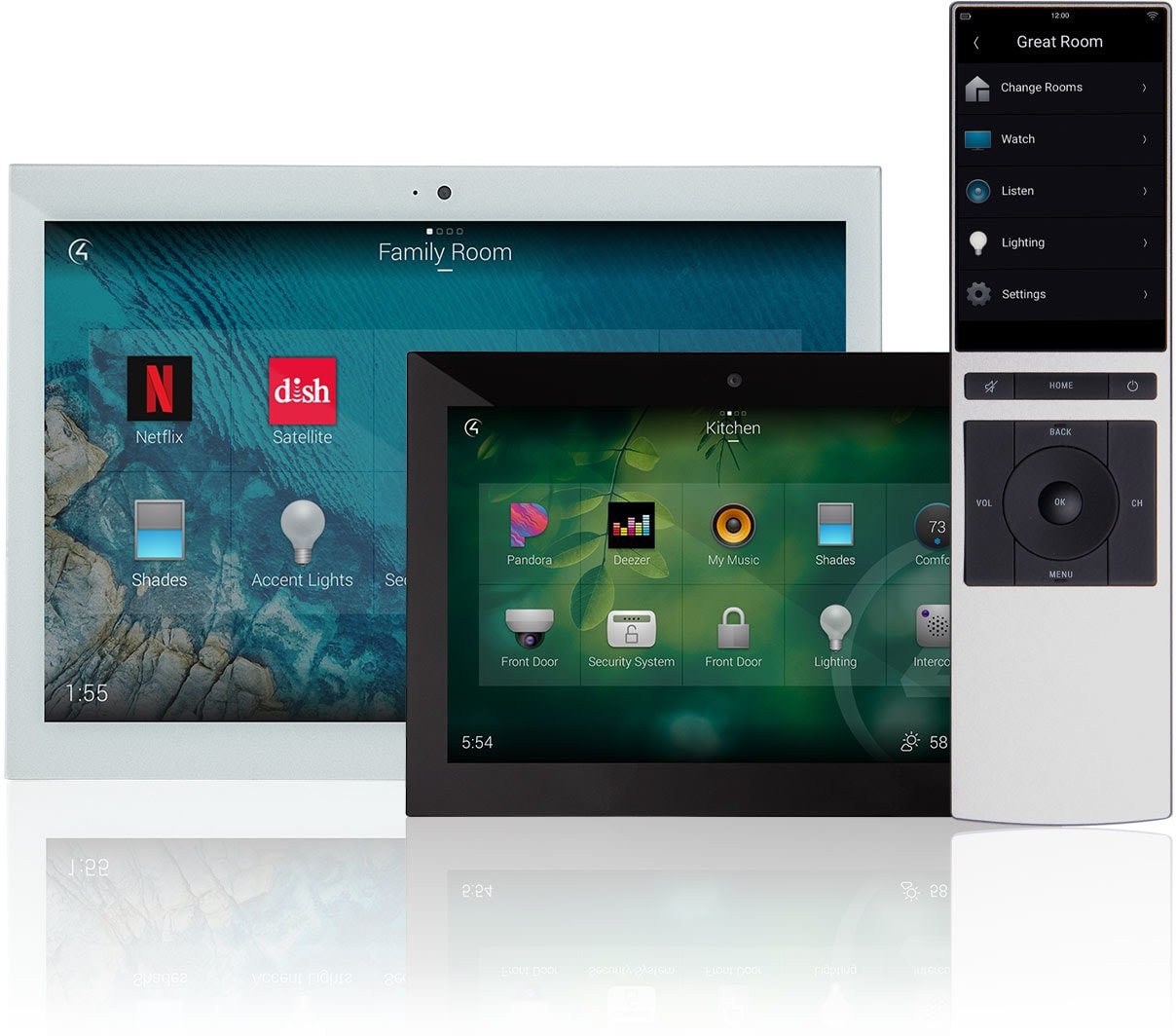
Control is the professional home automation platform we install most frequently for Toronto clients who want a comprehensive, reliable, and beautifully designed smart home system.
It's not a consumer product. You can't buy it at Best Buy or install it yourself. Control is sold exclusively through certified dealers and requires professional programming to work properly — which is exactly why it works so much better than anything you can buy off a shelf.
Here's what makes Control different in practice:
One interface for everything. Your lights, your thermostat, your music, your TV, your security cameras, your door locks, your motorised shades, your garage door — all visible and controllable from one app on your phone, one touchscreen on the wall, or one remote in your hand. Not six apps. One.
Scenes that actually make sense. Control is programmed — not just configured. When you tap "Movie Night", the living room lights dim to 15%, the shades close, the TV turns on, the Apple TV loads, the receiver switches to the right input, and the audio adjusts to your preferred volume for film. One tap. Everything. A consumer smart home system can sort of do this if the planets align. Control does it reliably, every time, because it's been programmed to.
It works without the internet. Control processes automation logic locally on the controller in your home. If your internet connection goes down, your automations keep running, your scenes keep working, and your lights keep responding. This is not true of most consumer smart home platforms, which become partially or completely non-functional without cloud connectivity.
It scales with your home. Start with lighting and audio in three rooms. Add climate control next year. Add motorised shades in the primary bedroom the following year. Control is designed to grow. Every addition integrates into the same interface.
Control system pricing in Toronto starts from approximately $8,000–$12,000 for a focused installation covering lighting and audio in key rooms and scales up from there. A whole-home control system for a 4–5-bedroom Toronto home with lighting, climate, audio, video distribution, security integration, and motorised shades typically runs $25,000–$60,000 depending on scope and equipment choices.
Smart Lighting Installation Toronto
Lighting is almost always the first thing we automate and the last thing people expect to make such a large difference.
The reason is that lighting affects how a space feels — the warmth of a room in the evening, the crispness of a home office at 9 AM, and the transition from a bright family dinner to a relaxed after-dinner — in ways that manual switches can't reproduce. You'd have to dim twelve individual switches to get your living room from dinner mode to film mode. With smart lighting, it's one scene, one tap.
What a professional smart lighting installation in Toronto includes:
Automated schedules. Lights that come on before you wake up, gradually brightening to simulate sunrise. Entry lights that turn on when you arrive home in the evening. Outdoor lights that turn off at sunrise and activate at sunset – not at a fixed time, but at actual sunset for your specific Toronto location, which changes throughout the year.
Motion-activated lighting. Hallways, bathrooms, and utility areas where you never want to fumble for a switch. Walk in, and lights come on. Walk out; they turn off after a configurable delay.
Scene-based control. "Dinner", "Movie", "Entertain", and "Sleep". "Away" — each scene sets every light in the relevant rooms to the right level and colour temperature for that activity. One button, one tap, one voice command.
Circadian rhythm lighting. Warm, amber light in the evening that supports natural melatonin production. Cooler, brighter white light in the morning that supports alertness. Some Toronto clients notice a meaningful improvement in sleep quality from this alone.
Keypad programming. Engraved keypads on the wall that replace standard switch panels and give every household member access to scenes without needing a phone. Clean, permanent, and instantly understood by anyone.
Lighting brands we install: Lutron (the gold standard for reliability — their RadioRA and Caseta systems are the most dependable wireless lighting controls available), Control lighting modules, and Philips Hue for colour-capable applications.
Smart Lock Installation Toronto
Smart locks are one of the highest-value smart home investments for Toronto homeowners — the ratio of practical benefit to installation cost is exceptional.
The ability to lock and unlock your front door from your phone, see a log of every entry, issue a temporary code to a contractor that expires at 5 PM, let your kids in after school without them carrying a key, and confirm your door is locked after you've left for the airport — these aren't conveniences that sound good in a brochure. They're things Toronto homeowners use every single day.
What smart lock installation from MV Tech Pro covers:
- Hardware selection based on your door type and existing deadbolt configuration — Yale, Schlage, and August are the brands we install most frequently
- Clean installation with correct backset fitting and proper alignment — a smart lock installed slightly out of alignment wears out prematurely
- Integration with your home automation system — so your lock status is visible in the Control app, your arrival unlocks the door automatically, and your departure triggers a lock confirmation
- User code management — setting up household member codes, guest codes with expiry, and contractor access with time and day restrictions
- Notification configuration — so you get an alert when the door is unlocked at an unexpected time
Smart lock installation in Toronto starts from $350–$600, including hardware and installation for a single door.
Smart Thermostat Installation Toronto
Ontario's climate makes smart thermostat installation one of the fastest-payback smart home investments available. Toronto winters average -5°C to -10°C and summers regularly reach 30°C+, which means your HVAC system is working hard for eight or nine months of the year.
A smart thermostat that learns your schedule and adjusts automatically — lowering heat when everyone leaves for work, ramping back up 30 minutes before anyone arrives home, and reducing cooling at 11 PM when the household goes to sleep — produces consistent energy savings with no behavioural change required from the household.
The Ecobee (designed in Toronto) and Google Nest are the consumer options we install for straightforward applications. For clients with Control or a whole-home automation system, we integrate with compatible thermostats that give the full automation platform control over HVAC – so your "Good Morning" scene doesn't just turn on the lights; it also adjusts the temperature for the morning routine.
For homes with multiple HVAC zones — which is common in larger Toronto homes and custom builds — we install multi-zone smart thermostats that control each zone independently based on occupancy and schedule.
Smart thermostat installation in Toronto: $250–$600 for a single unit, including configuration and app setup. Multi-zone systems quoted based on the number of zones and existing equipment compatibility.
Home Automation Systems Toronto — Whole-Home Integration
This is the full picture. Not one device, not one subsystem — everything working together as a single system.
A whole-home automation system from MV Tech Pro covers:
Lighting control — every room, every scene, automated schedules, motion activation, and circadian rhythm programming.
Climate control — multi-zone thermostat integration with the automation system, schedules that follow actual occupancy rather than fixed times, and HVAC status visible in the central interface.
Security and cameras – IP camera feeds are visible in the Control app and on wall touchscreens; motion detection alerts are sent to your phone; and integration with your alarm system means arming and disarming are part of your departure and arrival scenes.
Smart locks and access – front door, back door, garage, and any controlled entry point – are visible in one interface. Arrival and departure triggers that automate the lock state based on who's home.
Motorised window treatments are shades and blinds that open at sunrise, close on hot summer afternoons to reduce cooling load, adjust for privacy at dusk, and respond to lighting scenes so they close automatically when "Movie Night" is triggered.
Whole-home audio – Sonos or similar multiroom audio integrated into the control interface so music follows you through the house, plays in specific rooms for specific scenes, and is controllable from the same app as everything else.
Home theatre integration — your theatre system becomes part of the automation. "Movie Night" doesn't just set the lights and lower the shades. It also powers on the projector, switches the receiver to the right input, loads your streaming service, and sets the audio to your preferred movie volume.
Energy monitoring — visibility into what's consuming power in your home and when, with the ability to automate shutoffs for devices that don't need to run overnight.
Smart Home Upgrades Toronto — Adding Automation to an Existing Home
A significant portion of the home automation work we do in Toronto is in existing homes — adding smart technology to a property that was built before any of this existed.
The challenge with retrofitting smart home technology into a finished home is the wiring. Smart switches, keypads, and dimmers typically require a neutral wire at the switch location – and a large number of older Toronto homes, particularly those built before 2000, have switch wiring without a neutral. This isn't an obstacle, but it needs to be assessed before recommending specific hardware.
We audit your existing wiring first. In some cases, a small retrofit device allows smart dimming on two-wire circuits without a neutral. In others, we recommend running a neutral wire to key switch locations during the installation. In condos and apartments where wiring changes aren't practical, we specify smart home hardware that's designed specifically for two-wire retrofit applications.
For major home renovations – the best possible moment to add home automation infrastructure – we coordinate with your general contractor to rough in smart home wiring, conduit, and structured cabling during the framing stage before walls close. The cost of doing this during renovation is a fraction of what it costs to retrofit afterward.
Whole-Home Automation Toronto — New Builds and Custom Homes
If you're building a custom home in Toronto or the GTA, the conversation about home automation should happen at the architectural stage — not after drywall.
The reason is straightforward. A properly designed smart home in a new build requires the following:
- Structured cabling infrastructure planned around the automation system architecture
- Conduit routes for speaker wire, low-voltage control wiring, and HDMI are planned before framing
- Lighting circuit design that supports dimmer loads and scene control from the electrical plan
- Network closet placement and sizing for the automation controller, network equipment, and AV rack
- HVAC zoning designed around automation-compatible equipment
When all of this is planned at the design stage and installed during construction, the result is a genuinely smart home — where everything is concealed, everything is reliable, and everything works the way it was designed to. When automation is added to a finished home without this planning, you get a system that's part smart, part workaround, and partly held together by wireless bridges and creative cable routing.
We work directly with architects, builders, and interior designers on new custom home projects across the GTA. If you're in the early stages of a build, bring us in early. The conversation is free. The benefit of having it at the right stage is significant.
How Our Home Automation Installation Process Works
Step 1 — Discovery Consultation
We start by understanding how you and your household actually live. Which rooms do you spend the most time in? What are the daily routines that could be improved? What frustrates you about how the house currently operates? What do you want to happen when you arrive home? When do you go to sleep? When do you leave for work? This conversation shapes the entire system design.
Step 2 — System Design
We design your automation system around your lifestyle and your home's infrastructure. Which platform makes sense for your scope and budget? Which subsystems to integrate? What the wiring requirements are and whether any pre-wire work is needed. What scenes to build and how they should trigger. You see the full system design before any hardware is purchased.
Step 3 — Infrastructure Assessment and Pre-Wire
We assess existing wiring at switch locations, network closet placement, speaker wiring accessibility, and camera mounting positions. Where pre-wire work is needed, we complete it before any smart devices are installed.
Step 4 — Hardware Installation
Smart switches, keypads, thermostats, locks, cameras, audio equipment, and the automation controller are all installed. Every component is wired correctly, mounted cleanly, and positioned for the function it needs to perform.
Step 5 — Programming
This is what separates a smart home installation from a smart device setup. We program your scenes, your schedules, your automations, and your triggers. "Good Morning", "Away", "Movie Night", "Good Night", and "Guest Mode" — each one is programmed to do exactly what you described in the discovery consultation. The app interface is organised around how your household actually uses the system.
Step 6 — Walkthrough and Handover
We walk every member of your household through the system. Not just the person who was home for the install. Everyone who lives there knows how to trigger scenes, adjust settings, add a guest code to the lock, and check the camera feed. If anything feels wrong in the first weeks of use, we adjust the programming remotely or come back on-site.
Home Automation FAQ — Toronto
Can you automate an older Toronto home without major rewiring?
Usually yes, with some planning. The main constraint in older Toronto homes is the absence of a neutral wire at switch locations. We assess this during our initial visit and specify hardware accordingly – in many cases, smart switches designed for two-wire applications solve the problem without any rewiring. Where neutral wires are genuinely needed, the cost of adding them during a targeted installation is typically manageable.
Do smart home systems work during a power outage?
The automation system itself will not operate during a power outage — your equipment needs power to run. However, some components have battery backup options. Smart locks, in particular, can be specified with battery backup so they continue to operate and can be unlocked manually during a power failure. We discuss backup strategies during the design phase for clients who need this.
Will the system still work if my internet goes down?
With Control, yes — for local control. Your scenes, your automations, and your in-home control via app and keypads all continue to function because Control processes locally. What you lose temporarily is remote access from outside the home. Consumer platforms like Google Home and Amazon Alexa are much more dependent on cloud connectivity and may partially fail without internet.
Can you integrate with my existing security cameras or alarm system?
In most cases, yes. Control integrates with hundreds of security platforms and camera systems. We assess your existing equipment during the design phase and confirm compatibility before recommending any changes. If your existing camera or alarm is supported, we integrate it into the automation platform at no additional hardware cost.
How long does a home automation installation take?
A focused starter installation — smart lighting in key rooms, locks, and a thermostat — typically takes 1–2 days. A mid-range whole-home system takes 3–5 days. A full Control whole-home installation in a large Toronto home can take 1–2 weeks, depending on the scope. We give you an accurate timeline in the proposal and stick to it.
Ready to Secure Your Property With Professional Access Control?
Need this service?
Book an appointment with our experts today.